Stop building your discovery packages from scratch
Eve reads your case files and drafts interrogatories, RFPs, and RFAs from the facts, not a template.
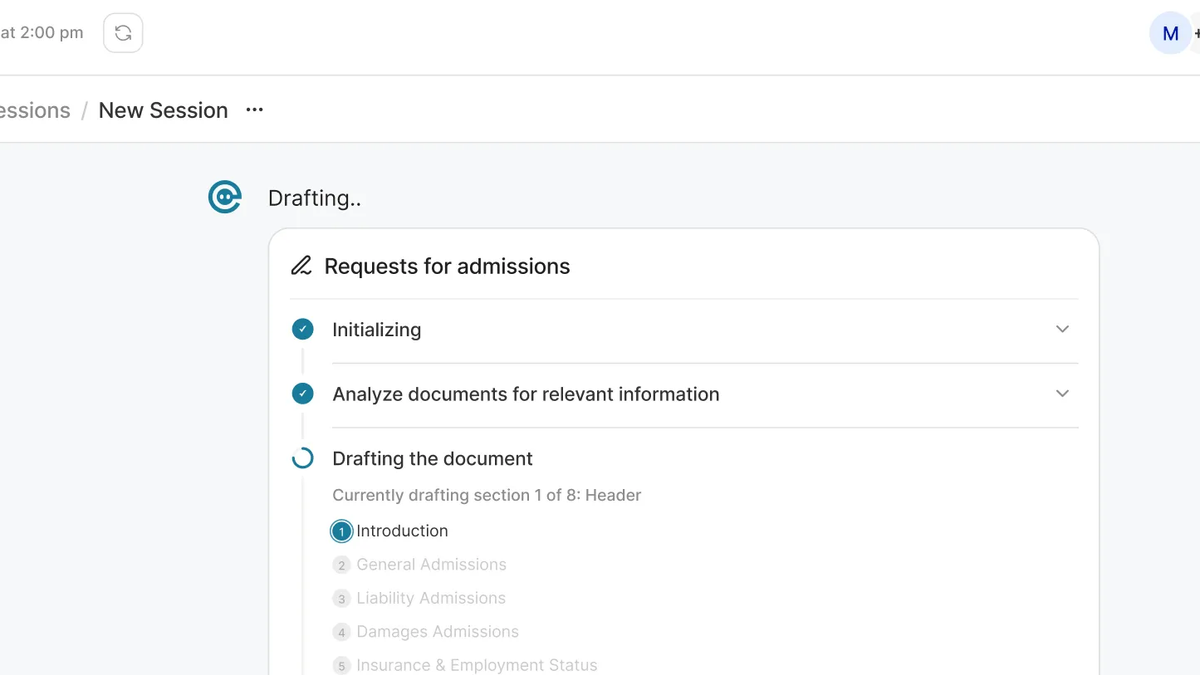
Eve reads your case files and drafts interrogatories, RFPs, and RFAs from the facts, not a template.









Go toe-to-toe with defense teams in both speed and power. Every request drafted from the facts of this case, in your firm's format.
Eve drafts interrogatories, RFPs, and RFAs from the facts, not a generic question bank. Point it at a theory of liability and it digs deeper.
Eve learns your definitions, structure, and phrasing from discovery you've already filed. Every draft starts from your best work, not a blank page.
Tell Eve how many requests each defendant needs. It drafts a distinct set for each, with definitions and numbering consistent across parties.
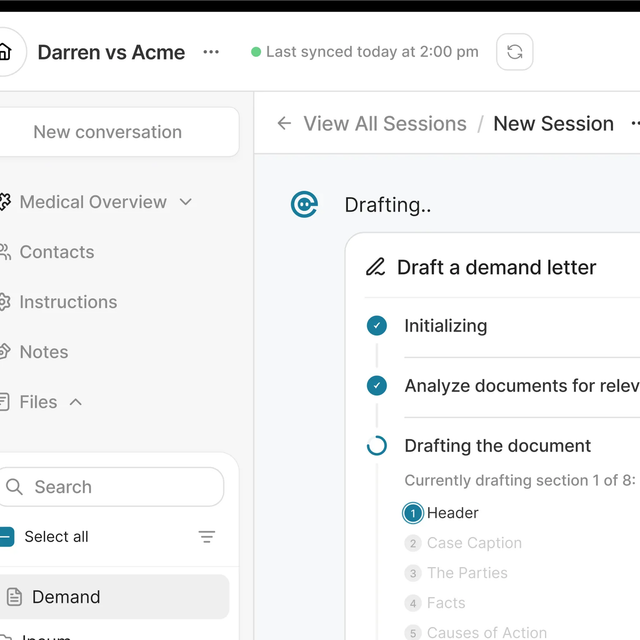
The complaint, police reports, medical records, intake notes. Whatever holds the facts of the case.
Pick an agent trained on discovery you've already filed, then say what you need: "20 special interrogatories and 25 RFPs to Defendant Smith."
Requests come back written from the facts, in your formatting and definitions. You control what goes to opposing counsel.
“Eve helps our attorneys quickly sort through documents and facts to get to the heart of a legal matter. With Eve, we can effortlessly draft discovery documents and communications – all in the tone and style of our firm.”

“You don't have to have 20 years of litigation experience to be great at drafting discovery. Eve is like having a very good senior associate who works at the speed of light with encyclopedic knowledge of every document in your case.”

“Eve has transformed our document production — from demand letters to discovery documents — enhancing our case strength and winning potential.”

“The drudgery of handling written discovery is now minimal. Eve handles all the difficult and boring work. I am free to think about the big picture and make the important and persuasive arguments. But I want to keep it a secret because now I have a leg up on the competition.”

Eve analyzes the documents you've uploaded — police reports, medical records, intake notes, pleadings — and generates interrogatories, RFPs, and RFAs tailored to the facts of that case. It's not pulling from a static question bank. If your case involves a trucking accident, Eve will draft questions relevant to trucking; if it's premises liability, it'll focus on inspection records and maintenance. You can also add instructions to focus on specific theories or issues.
Yes. You can build separate drafting agents for MVA, trucking, premises liability, medical malpractice, employment, or any other case type your firm handles. Each agent learns from your best examples of that specific discovery type, so a trucking interrogatory set won't look like a garden-variety auto set. The more granular you get, the better the output.
Yes. You can upload your existing question banks to Eve's Central Library and instruct it to select the most relevant questions for each case, then supplement with case-specific requests based on the facts. Firms with 100+ standard interrogatories use this approach to combine their proven language with AI-generated, fact-driven additions — so you keep what works and let Eve fill the gaps.
Eve generates case-specific discovery questions and can format them to match your firm's style, captions, and structure when you use a drafting agent trained on your completed examples in Word format. Upload two finalized sets of propounded discovery as examples, and Eve will learn your formatting — including headers, party names, definitions, and legal instructions — alongside the substance.
Traditional discovery libraries give you a menu of generic questions to manually select from. Eve reads your actual case files and generates questions tailored to the facts. Instead of choosing from a list, you get a draft that already reflects what happened in this specific case. You still review and refine, but the starting point is case-specific, not generic.
Typically 10–15 minutes for a full set of interrogatories, RFPs, and RFAs. You can run multiple cases simultaneously, so a paralegal could kick off discovery generation for 10–15 cases at once and review the output as it comes in. Compare that to manually drafting or copy-pasting from old files case by case.
Match speed and quality of discovery requests to get to resolution faster.