Opens claims with insurance providers
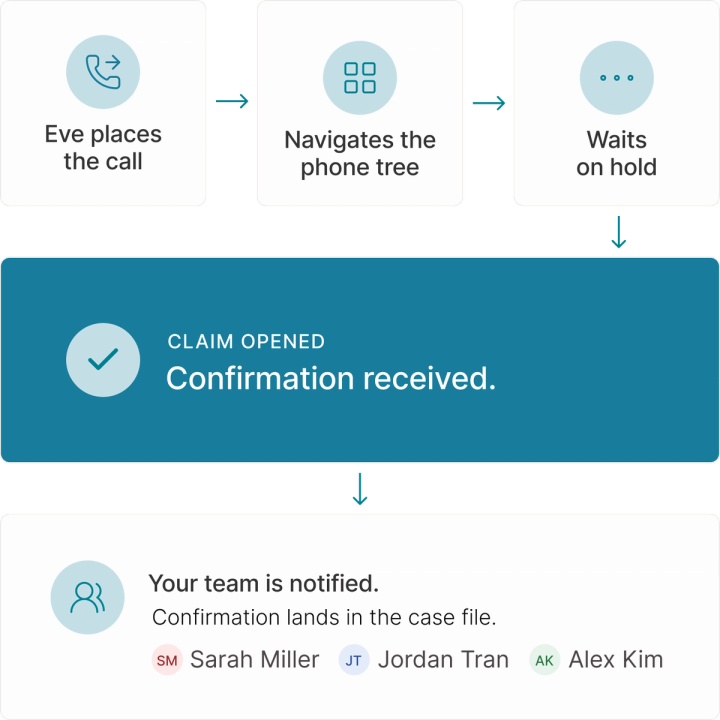
Eve navigates the phone tree, sits on hold, and opens the claim. Your staff reviews the outcome — not the hold music.

Eve Comms Agent opens claims, checks in on treatment, follows up on medical records, gathers discovery details, and provides case updates, so your team isn't spending all day on the phone.










Eve navigates the phone tree, sits on hold, and opens the claim. Your staff reviews the outcome — not the hold music.
Eve finds what’s missing in discovery and calls the client to fill the gaps. Your team gets a structured summary ready to draft from.
Eve monitors what’s still pending and proactively follows up with providers to get records delivered. Activity is logged to the matter for at-a-glance status updates.
Eve reaches out so clients know their matter is moving. Fewer “What's the status?” calls to field.

Eve calls clients on a cadence you set, asks questions grounded in their cases, and surfaces what needs attention: treatment gaps, new symptoms, and missed appointments.
Plan
First, Eve pulls case context — notes, prior calls, treatment history — and creates a tailored a call plan. You review and edit before approving.
Call
Eve navigates the IVR, handles voicemail, and retries if needed. If the call requires a human, Eve transfers live, with context.
Summary
Every completed call generates a summary on the matter. Exceptions are flagged so nothing falls through.
Scale
Comms agent makes calls for one matter or your entire caseload. Run it manually, on a schedule, or kick off on case updates or Auditor findings.
“The efficiency gains here are monumental. We're looking at dozens of hours saved per month for every single case manager.”

“The ability to save our staff the simple, but extremely tedious and time-consuming calls they have to make in almost every case will be significant.”

“By automating these routine interactions, firms can reduce client communication workload by 40–50%, or better yet, reinvest that time into higher-quality conversations that actually move the case forward, build trust, and increase value.”
Eve navigates automated phone menus: the press 1, wait, press 3, get transferred experience. No more burning 45 minutes to reach an adjuster.
No answer? Eve leaves a message and tries again. If it can't get through, it flags the matter and moves on.
You define the conditions, like a distressed client or a request to speak with a lawyer. Eve transfers live, with context.
Eve calls in 30+ languages. Your clients hear it in theirs.
A paralegal works down a call list, leaves voicemails, retries manually
Eve runs check-ins on schedule. Summaries land on the matter automatically.
Staff sit on hold, navigate IVR trees, get transferred or hung up on
Eve calls the insurer, navigates the IVR, opens the claim. No staff on hold.
A daily chase to get medical records, costing your team hours every week.
Eve tracks what's outstanding and follows up until the records arrive.
Case managers make the calls when they can. Clients call regardless.
Eve reaches out proactively. Inbound "What's happening?" volume drops.
Paralegals comb the file for gaps, then play phone tag trying to reach clients for missing details.
Eve reviews open discovery requests, calls the client to fill the gaps, and delivers a structured summary.
A paralegal works down a call list, leaves voicemails, retries manually
Eve runs check-ins on schedule. Summaries land on the matter automatically.
Staff sit on hold, navigate IVR trees, get transferred or hung up on
Eve calls the insurer, navigates the IVR, opens the claim. No staff on hold.
A daily chase to get medical records, costing your team hours every week.
Eve tracks what's outstanding and follows up until the records arrive.
Case managers make the calls when they can. Clients call regardless.
Eve reaches out proactively. Inbound "What's happening?" volume drops.
Paralegals comb the file for gaps, then play phone tag trying to reach clients for missing details.
Eve reviews open discovery requests, calls the client to fill the gaps, and delivers a structured summary.
For client-facing calls, you control which agents handle which matters. If a client wants to speak with a human, Eve transfers live. For high-sensitivity matters (e.g., wrongful death, catastrophic injury), Eve will route calls directly to a human. If a client doesn't want AI contact, Eve won't call back and flags it so you know.
Many personal injury firms start with insurer and provider calls, and allow clients to opt in or out of AI use when onboarding them.
“The voice agent is personable, conversational, and empathetic when it matters. It doesn't feel like a checklist call — clients actually enjoy the interaction.”
No. It handles the routine, repeatable outbound calls, like claims opening, treatment check-ins, case updates, medical records collection follow-up, and discovery info gathering. Case managers handle the calls that require judgment, empathy, or legal knowledge. Most firms find their team shifts from making the same call multiple times to reviewing what came back — whether that's a personal injury practice running treatment check-ins, a workers' comp firm tracking claim status, or a mass tort team managing case updates across a large docket.
Yes. You control which agents run for which use cases. Firms that prefer to start with provider-facing and insurer-facing calls — and keep client communication human — can configure it that way.
Before each call, Eve reads the matter record — prior call summaries, case notes, treatment history — and builds a tailored call plan. You review and approve the plan, and can edit it, before the first call goes out. Nothing goes to a client or insurer without your sign-off.
Yes, according to the disclosure rules you configure. You control when and how Eve introduces itself. If a contact asks directly whether they're speaking to an AI, Eve answers truthfully.
Eve detects voicemail and handles it according to your configuration. It can hang up, leave a static message, or speak a generated one. If the contact doesn't answer, Eve retries a configured number of times before flagging the matter for manual follow-up.
For calls to insurers and providers, there is no TCPA exposure, as those are B2B contacts.
For client-facing calls, enabling automated outbound requires you to confirm that clients have given consent: through intake language, a signed authorization, or your standard process. Every call includes a disclosure at the start, and clients can opt out of future outreach at any time.
Find out how plaintiff firms are automating recurring calls to get more time back