


The premier publication for plaintiff law
How Plaintiff Firms Use AI for Legal Research Beyond Case Law
Bring case law, medical literature, regulations and benefits guidance into the case—and put that research to work in a demand or motion.

By Janet Choi — 6 min read
The Tort Report
One email a week on the verdicts, the AI, and the money reshaping plaintiff law. Read by 500 leading plaintiff firms.
We could not load the signup form. Email us and we will add you to The Tort Report.
Email usThe strongest plaintiff cases start with the full picture. Of course, precedent matters, but so do the medical findings behind a causation theory, the regulations a defendant had to follow, and the benefits rules that apply to a claim.
Mid-case, that can mean tracking down information that’s seldom in the case file: a judge’s standing order, a study tying the injury to the crash, the current benefits rule, and the case that gets key evidence in front of the jury.
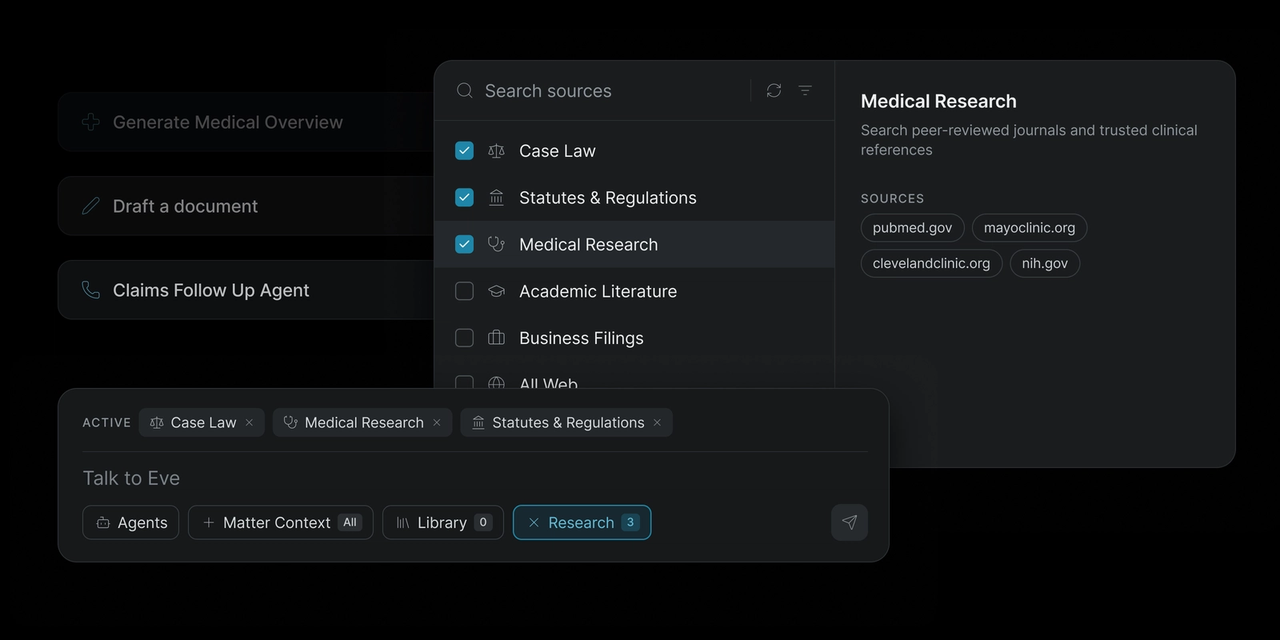
Eve Research is AI legal research built into the case. You can search case law, medical literature, regulations and benefits guidance from trusted sources you can check, then put what you find to work in the demand or motion.
What plaintiff firms need from AI for legal research
AI for legal research finds and applies authority to a question. For plaintiff firms, it also has to reach beyond case law and work from current sources.
Much of that information can change over time. For instance, Social Security adjusts its disability earnings limit every year, California recalibrates its disability caps every year, and California’s civil jury instruction updates go up for approval at least twice a year. Firms that download these sources and keep their own copies risk working from stale versions.
The usual tools don’t solve this. Traditional research databases can keep research a step removed from the case, and AI features may depend on the product and come at added cost.
Without access to current sources, a general-purpose chatbot may rely on information from before its training cutoff. Even with web search, attorneys need to check the sources and citations. When a question goes past what a model knows, it can produce a citation that looks real and isn’t. (As of November 2026, Damien Charlotin’s AI Hallucination Cases database lists more than 1,500 U.S. court decisions addressing AI-hallucinated content in filings.)
The answer isn’t to avoid AI but to use AI that works from current, trusted sources, inside the case you’re already working.
How plaintiff firms use AI for legal research across the case
Research comes up across a case: before a filing, while drafting a demand, ahead of a deposition. Here’s how plaintiff firms use Eve Research throughout the case, with case law and medical, regulatory and benefits sources in one place.
Bring medical literature, regulations and benefits guidance into the case
Plaintiff cases rarely rest on case law alone. A trucking case can turn on the Federal Motor Carrier Safety Regulations, a med mal case on the peer-reviewed literature behind a causation theory, a benefits appeal on the guidance an agency applies.
Eve’s built-in collections cover medical research, academic literature, business filings, and statutes and regulations. A medical question can draw on sources like PubMed, Mayo Clinic and Cleveland Clinic.
For public sources a practice leans on every week, firm admins can set up custom collections, which work like bookmark folders that Eve searches directly. A firm handling veterans’ benefits claims, for example, can build one around the VA’s M21-1 claims manual, so benefits questions can draw on the current version. They’re limited to public sites, not paywalled or logged-in sources.
Steven Shaw, owner of Shaw Legal Solutions, put that research straight into a demand.
“We were able to go to the insurance company with a well-reasoned demand, including some PubMed articles that Eve went out and pulled in that really supported our position,” Shaw says. “Because we were able to fast track everything and really put together a beefy demand we got a policy limits offer in a couple weeks — which is unusual.”
Search case law from court sources
Eve’s case law comes from PACER and state court portals and covers more than 2,000 courts. Eve searches the text of the opinions themselves, not summaries or headnotes, and entries are updated every day. Coverage centers on federal and state appellate authority plus federal district court opinions. State trial court opinions and secondary sources generally aren’t included, but available sources continue to expand.
Eve can format citations for the court you’re filing in, or in Bluebook if you ask. Click a cited case to open the full opinion, with details such as its court, date, disposition and, where available, how later courts have treated it.
Check court procedure before you file
Some of the most time-consuming research is procedural, like what this court or judge requires: a standing order, a form, a filing requirement, a deadline rule. Ask Eve the way you’d ask a colleague, and it uses the case’s court and jurisdiction to focus the search.
Matthew Jones, a legal intelligence specialist at Bell Law, uses it to catch standing orders and pull the right court form.
“The research function has helped to be more on top of things like requirements, or standing orders… Once when I was preparing a subpoena, I didn’t have to go through the court website or look up the link for the form on Google. I could just click on it in Eve and fill it out with the information it gave me.”
Draft with the research already in place
Research is most useful when you can apply it right away. In Eve, research happens in the same workspace where you draft the demand, motion or brief. A regulation violation you find can become a paragraph in the demand, a medical study can back a causation argument, and the supporting cases arrive with the draft instead of after it. Save the cases you’ll come back to in the case or the firm library.
For common research tasks, Eve’s research agent templates give your team a starting point: a first-pass research memo in IRAC format, a cite-checking pass on a draft argument, and a responsive argument builder for answering the other side’s brief. Firms adapt them to how they work.
Find the arguments you didn’t search for
Because Eve works from the case file, it can surface authority, studies and arguments you might not have gone looking for.
Say you’re preparing for trial. Ask Eve to review the file and list potential motions in limine. You pick the ones worth filing, Eve drafts them with supporting case law, and you review and cite-check.
The same approach works before a deposition or a negotiation. Ask where an opposing expert’s background and foundation are weakest, which medical literature answers a causation theory the defense will lean on, or whether a defendant’s business filings square with a claim that it can’t pay.
Eve can help widen the field. You decide which angles are worth pursuing.
Check sources and citations before you file
Eve’s answers include citations to the sources behind them, such as opinions from its case law database or pages from a medical, regulatory or benefits collection, so you can open them and check what they say. Whether a source supports the point it’s cited for is still yours to confirm.
Keep your citator for final cite-checks. Have an attorney review and verify every citation before anything is filed.
Can you trust AI for legal research?
You can trust AI legal research as a starting point when it’s grounded in real sources you can open and read, and when you still verify before filing.
With Case Law Search on, Eve retrieves cases from its own database rather than recalling them from model training, and cited opinions open in Eve so you can read them. Medical, regulatory and benefits answers draw on the collection you picked and point back to their sources. That shifts the check toward whether a case supports the point it’s cited for. Pin cites, publication status and treatment flags still need an attorney’s review.
Considering Eve Research for your firm?
Everyone at your firm on Eve can use it, including paralegals and case managers, so basic research doesn’t have to wait on an attorney with a database login. Eve Research is included in the base price.
“Eve helps me write motions in limine, like, brilliant ones. Then, I go through and cite-check. Overall, Eve does phenomenally well,” says Chadwick McGrady, owner of the Law Office of Chadwick McGrady, P.C.
Finding the right source is half the job. The other half is using it. Explore Eve Research or get a demo for a walkthrough at your firm.
Related Stories



The Tort Report
One email a week on the verdicts, the AI, and the money reshaping plaintiff law. Read by 500 leading plaintiff firms.
We could not load the signup form. Email us and we will add you to The Tort Report.
Email us