


The premier publication for plaintiff law
The Expert Who Called the Jury Stupid Cost Continental $896 Million
Jon Marko found the AI transcripts the night before cross, in a 20,000-page dump from a defendant that never offered a dollar.

By Adam Ramirez — 6 min read
The Tort Report
One email a week on the verdicts, the AI, and the money reshaping plaintiff law. Read by 500 leading plaintiff firms.
We could not load the signup form. Email us and we will add you to The Tort Report.
Email usA defense expert told Continental’s lawyers the jury was stupid. Give it an anchor number, he said, or the panel could award hundreds of millions of dollars. Then he asked what number they wanted in his report.
An AI note-taker caught every word.
The transcripts were buried in 20,000 pages a judge had forced out of the defense on a 48-hour deadline. Jon Marko found them the night before he cross-examined the man.
“I started jumping up and down,” Marko told me. “Never in my career.”
When that trial ended, an Oakland County jury awarded $896,467,970 to Elijah Gibson, who was 8 when a prototype car on a test track hit a guardrail and the children standing behind it on a summer-camp field trip. The verdict is believed to be the largest single-plaintiff verdict in Michigan history.
Two more juries followed, one for Elijah’s father and one for the other boy hurt that day.
Three trials in one summer, more than $931 million, and Continental never offered a dollar.
The expert, it turned out, had the number about right.
Continental admitted fault, and the plaintiffs lost their best evidence.
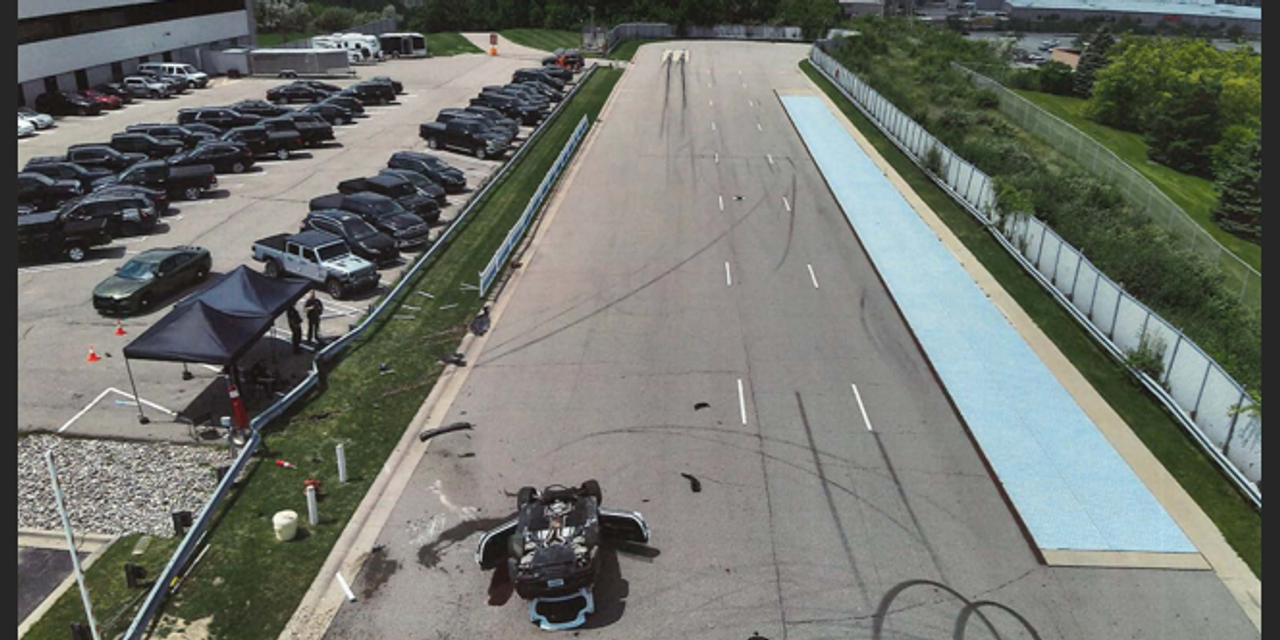
The crash happened on July 17, 2023, at the Auburn Hills test track of Continental Automotive Systems, the U.S. arm of the German tire and auto-parts giant (the business has since been spun off as Aumovio). A STEM summer camp had lined a group of kids up behind a guardrail to watch a demonstration. The car was a Ford Mustang Dark Horse prototype. The driver was a 20-year-old engineer three months into the job, and Marko says the traction and braking controls had been switched off.
The driver lost the car out of a turn at about 55 miles an hour and put it through the guardrail and into the boys. Elijah, 8, suffered skull fractures, a traumatic brain injury and broken legs. Lavell McGee, 10, suffered head injuries. While the children were still on the ground, Marko alleges, a Continental executive was on video with company counsel, looking for liability waivers and telling people at the scene not to cooperate with police.
For two and a half years Continental fought liability, so Marko built it: more than 70 depositions, four experts, more than half a million dollars in case costs. Then, a few weeks before trial, Continental admitted liability. Not causation, just liability. “They would not have admitted liability had we not done that,” he said.
Most lawyers would call that a win. Marko calls it the moment the case got harder. Judge David Cohen cut out much of the evidence the admission had made unnecessary. The 20-year-old driver with a few months of experience, the training he never got, the supervision that never happened, all of it was off the table.
“All those anger points from the jury were taken out,” Marko told me. “We had to find different anger points.”
The defense got to walk in contrite. Marko’s answer to the jury was simple. Continental had been sorry for a few weeks. Where was the apology two years ago, or one?
Continental bet the trial on its experts.
With fault conceded, Continental’s lawyer, Jonathan Ebner of Clyde & Co., spent his opening on Elijah’s report card. The boy’s grades had come back. The behavior problems Marko described were what you’d expect from any adolescent. He suggested the jury land somewhere around $10 million, and he asked for compensation, not punishment.
Marko had been framing the injury the opposite way since the day he filed. The boys, he told CBS Detroit in 2024, had gone from “top of their class overachievers” to “struggling with some of the most basic things.”
That’s the admitted-liability playbook. Concede what you can’t win, then make the trial about whether the plaintiff is really that hurt. Continental brought experts to say he wasn’t.
One of those experts kept AI notes.
Marko went after the experts’ bias. Judge Cohen had ordered the defense experts to turn over their financials, and Marko’s team used Eve to build cross charts out of them: earnings by year, client lists, and the gaps in what each expert had actually produced. “Some of these guys made millions of dollars,” Marko said. “They were hired guns.”
Then came the life care planner. Marko didn’t lead with the notes. Michigan lets a cross-examiner put in anything an expert relied on, so he walked the witness through his reliance materials one at a time. Medical records, yes. Interviews, yes. His own notes? Yes, of course.
Then Marko moved them into evidence and put them on the screen. He heard the jury gasp. The witness, he says, sank in his chair and smiled a nervous smile.
His explanation was that the transcripts were fiction, a story he’d generated with an AI program to read at night with his wife. Marko had already found the entry that killed that story. On a Friday when a juror was sick and trial was adjourned, defense counsel had met with the expert, and the notes opened with a lawyer introducing herself by name and laying out what she needed from him on Monday.
“You think I’m stupid?” Marko asked him. “You think they’re stupid?” It came out rapid fire, he says. Nobody objected.
Afterward, he says, Judge Cohen told the lawyers that in 40 years on the bench he’d never seen a more eviscerating cross-examination.
The expert had warned the defense that without an anchor the jury might award hundreds of millions. The defense anchored at $10 million. The jury went to $896 million.
Continental could have settled for about $60 million.
A mediator had floated a number north of $60 million before the first trial. Marko thought it was low. The families were ready to take it. Continental declined, and never countered.
Zero after the first verdict. Zero after the second. Then a third trial with nothing on the table.
“Complete lunacy,” Marko said. “It’s a mess behind enemy lines,” he told Courtroom View Network after the first verdict. His theory is that the problem sat on Continental’s side of the room: a disconnect between trial counsel and the company’s German insurers, a string of law firms on the way to trial, and a coverage tower he puts in the hundreds of millions, with excess layers he didn’t learn about until a week before trial, two and a half years in. Judge Cohen sanctioned Continental $1 million over the coverage disclosures and awarded roughly $930,000 in fees. Marko believes the primary carrier never properly notified the excess carriers, and that the upper layers are now disputing the claim.
Continental did learn from the first trial, in its way. By the third, it had withdrawn the experts Marko had taken apart, so he couldn’t impeach them again, and the judge had narrowed the evidence further. By then Ebner was telling jurors that Marko was “overreaching,” a self-described aggressive plaintiff lawyer chasing a number the injuries didn’t support. Marko is candid that $32.7 million for Lavell and $2.07 million for Elijah’s father, Vincent, believed to be the largest bystander verdict in Michigan history, both disappoint him. The judge barred him from telling the bystander jury about Elijah’s injuries. That ruling is headed to appeal.
“It’s hard to come back after you get a $900 million verdict,” he said.
Vincent Gibson put it differently to Detroit’s WDIV in September. The jury, he said, “gave us the justice the company refused to offer.” Continental has not commented publicly on the verdicts.

Read the document dump yourself.
Marko tried all three cases back to back, with John Eads of his firm and Scott Goodwin beside him, and handled all but a handful of the witnesses himself. He calls it a gauntlet. He also says he went gray over it. “I’m a control freak,” he said. “I wouldn’t recommend it.” What he does recommend is getting close to the family. “We laughed together, cried together,” he said. “I think that showed.”
He has two takeaways. Do the work, because the admission only came after 70 depositions and half a million dollars in costs. Then keep digging, because the thing that wins the trial can be sitting deep in a dump nobody expected you to read.
The lesson for the rest of the bar is in what Continental’s admission actually was. A defendant that concedes fault is betting you have nothing else. Marko had 20,000 pages and one night.
Related Stories

The Tort Report
One email a week on the verdicts, the AI, and the money reshaping plaintiff law. Read by 500 leading plaintiff firms.
We could not load the signup form. Email us and we will add you to The Tort Report.
Email us