


The premier publication for plaintiff law
Local SEO for Personal Injury Lawyers: 7 Google Business Profile Moves for 2026
Google pins three firms to the top of the map for every injury search, and those three get the calls. Here's what puts a firm among them.

By Janet Choi — 9 min read
The Tort Report
One email a week on the verdicts, the AI, and the money reshaping plaintiff law. Read by 500 leading plaintiff firms.
We could not load the signup form. Email us and we will add you to The Tort Report.
Email usWhen someone in your city googles "car accident lawyer," the first thing they see isn't a big list of blue links. At or near the top of the results, they'll see a map with three firms pinned to it. That's the Google local pack, also called the "map pack" or "3-pack". (Typically the map pack appears below paid Local Services Ads.)
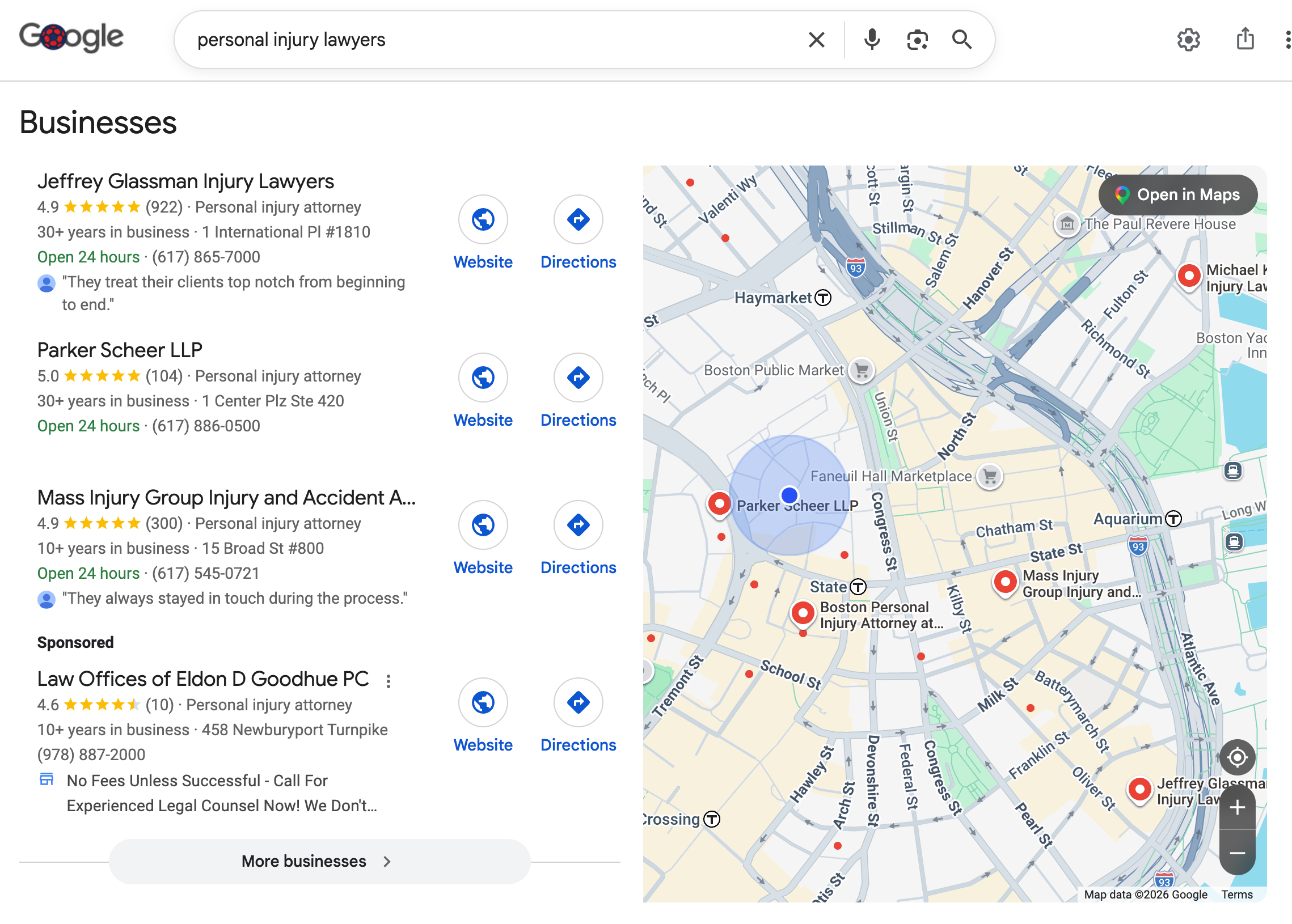
The firms in the local pack collect a disproportionate share of the calls. For a personal injury firm, that block is the most valuable real estate in search. That's what makes local SEO for personal injury lawyers worth the effort: even if you don't land in the map pack, the same optimizations help you rank higher in local results.
The Google Business Profile (GBP, formerly Google My Business) is pivotal to appearing in the local pack. It's a free profile that lets you control how you appear in Search and Maps, manage your reviews, and reach new clients.
Most PI firms treat GBP as a directory listing they set once and forget. The firms winning the map pack treat it as an asset they manage every week.
What actually moves local SEO for personal injury lawyers
Here are the seven Google Business Profile moves that give a personal injury firm its best shot at the local pack. None is complicated; most cost nothing but consistent attention.
1. Get your primary category right
Primary category is the single most important thing you set on your profile, according to Whitespark's 2026 Local Search Ranking Factors report, a survey of 47 local search experts.
Your primary category tells Google what your business is, and a surprising number of firms get this wrong. They choose something broad like "Law Firm" when they should be telling Google precisely what they do. The correct primary category for a PI practice is Personal Injury Attorney.
Once your primary is set, fill your secondary slots with categories that match your practice areas, things like car accident lawyer, wrongful death attorney, and slip and fall attorney. Each one expands the searches you're eligible to appear for.
Add what fits and stop there. Real PI profiles routinely carry categories that have nothing to do with the work, anything from Barrister to Aviation consultant to Nursing home provider, and every off-target category muddies the signal. The test is simple: if a category doesn't describe a service you'd actually take a case for, drop it. The ones that don't fit won't widen your reach; they make it harder for Google to know when to show you.
Picking the wrong primary category outright is also one of the strongest negative ranking factors in local search, so this is worth getting exactly right.
2. Build a review system, not a review push
Google reviews pull double duty: they help you rank, and they help you convert once a prospect finds you. Searchers trust a firm with many of them over one with only a few.
In 2025, SearchLab Digital studied 3,200 personal injury Google Business Profiles across 20 U.S. cities, comparing the firms ranking #1 against those at position 10. They found that firms ranking #1 carry roughly 40% more reviews than firms at position 10, 555 against 395 on average.
Review signals are also among the fastest-rising local ranking factors heading into 2026, so volume built steadily now compounds into an advantage that keeps growing and signals recency to Google. The 40% volume gap between position 1 and position 10 isn't the product of one good month. It comes from an ongoing cadence.
Resist the instinct to chase a perfect score, too. Go lower than about 4.4 and you start losing trust; sit at a flawless 5.0 and it actually reads as suspicious, since clients know a real practice picks up the occasional unhappy review. Reply to every review, including the negative ones, to build trust and credibility.
You can build the review ask into your case lifecycle so it runs without anyone remembering to do it. A simple sequence after a case resolves works well, and you can draft the whole thing quickly in an AI tool with a prompt like:
"Write a 3-touch review request sequence for a PI law firm to send after case resolution. Touch 1: email at resolution. Touch 2: SMS 3 days later. Touch 3: email follow-up at 10 days. Each under 75 words, warm but not pushy."
3. Fill out your Google Business Profile
This one might sound self-evident, but a half-finished Google Business Profile leaves easy signals unclaimed. Work through each key section.
Start with your NAP, the name, address, and phone number, which must match your website and your directory listings exactly. Inconsistency here confuses both Google and clients. SearchLab Digital also found that, on average, 41% of firms did not have a matching phone number between their website and profile.
Write a real business description, up to 750 characters, covering your practice types and the geography you serve, ending with a clear call to action. Fill out the services section with one entry per practice area and a short description of each. And add your social media links: 99% of position 1 firms have them on their profile, and adding yours takes minutes.
Read Google's guidelines, use tools like Semrush's GBP optimization tool, or talk to your SEO agency to make sure you're effectively filling out every empty field on your Google Business Profile.
4. Photos and posts help you convert, not rank
Some firms over-invest in photos and posts expecting rankings. Neither moves your position, but both can move whether a prospect who finds you decides to call.
The belief that photos lift local rankings, including the popular idea that geo-tagging images helps, is widely treated as a myth, and the PI data bears that out. Position 1 firms carry 84 photos on average against 74 at position 10, and the top firms actually had older most-recent uploads than lower-ranked firms.
So don't chase freshness for its own sake. Build a quality library, office interior, exterior signage, your team, community involvement, and refresh it on a sane monthly rhythm, because it shapes a prospect's first impression.
Google Posts work the same way. They're a conversion aid, not a ranking signal. Position 10 firms post more often on average, but position 1 firms post more recently. Recency reads as a living, active practice; raw volume doesn't separate anyone. A regular, client-focused cadence is plenty, covering FAQs, a case type, a local legal tip, a firm update, community involvement. You could batch a month or two at once with an AI prompt like:
"Write 8 GBP posts for a PI law firm in [city]. Each under 150 words. Cover: a case type, a local legal tip for accident victims, a firm update, and a community involvement post."
5. Fix your UTM tracking so you can see what's working
Fixing your tracking doesn't change your rankings, but it gives you visibility into how your efforts are paying off. According to SearchLab Digital, nearly half of PI firms have no UTM parameters on their profile's website link, and 43% use the wrong medium.
UTM parameters are the small tags appended to a link that tell your analytics where a visitor came from. Without them, the traffic your profile sends to your site shows up as unnamed or "direct," indistinguishable from someone typing your URL by hand. You end up unable to measure the very channel you're investing in.
The correct setup is straightforward. Tag your website links with utm_source=google, utm_medium=organic (lowercase, every time), and utm_campaign=gbp. Add the same tracking to your appointment link and any service links on the profile. Once it's in place, every call and click your profile drives becomes something you can see, attribute, and act on.
6. Your website now has to close the call
Google has phased out the call button on Business Profile listings for service-category businesses. So a prospect who finds you in the map pack now clicks through to your website to call rather than tapping a number on the listing itself.
For the path from "I found this firm" to "I'm dialing" to be as short as possible, the click-to-call has to be prominent and above the fold, and the page has to load quickly on a phone.

A mobile-responsive site is among the strongest conversion factors in local search, yet 5% of PI firms still aren't responsive and 8% still lack HTTPS, a ranking signal since 2014. If a prospect arrives ready to call and your mobile site fights them, the profile work that got them there is wasted at the finish line.
7. Ask Maps and the shift to being recommended
The Q&A feature on Business Profiles is gone, removed in late 2025, so there's nothing left to optimize there. In its place, Google has introduced Ask Maps, a Gemini-powered feature that lets people ask Maps a natural-language question, "Is there a PI lawyer near me who handles truck accidents?", and get a personalized recommendation drawn from profile data, reviews, photos, and website content.
This feature is new, and it's unclear exactly what gets into the answers Ask Maps returns.
Still, Ask Maps likely surfaces the businesses Google feels confident recommending, so a strong profile, the right category, and a current body of reviews now feed an AI recommendation engine rather than just sorting a static list.
The broader research points the same way: review signals are gaining weight in local search, and a firm's depth of focus on its niche increasingly shapes how AI search surfaces it. You're building a profile Google trusts enough to put forward in a conversation, which makes the accuracy of everything above matter more.
Common problems that quietly cost PI firms
A few recurring issues do real damage, and they're worth checking before they cost you a ranking or a profile.
- Suspended profiles. Stuffing keywords into your business name or listing a virtual office are among the fastest ways to get suspended. Use your real name and a real, staffed address.
- Duplicate listings. Old listings left behind by office moves or departed employees split your signals. Find and consolidate them.
- Multiple locations. Each office needs its own profile with its own NAP and its own reviews. Don't try to run several offices through one listing.
A monthly maintenance rhythm
The firms in the top three pins keep getting the work done after the initial setup. A short monthly pass keeps you competitive:
- Check review velocity. Are you on pace to out-earn your local competitors this month?
- Confirm your posts are recent, not stale.
- Review and approve or reject any profile edits third parties have suggested.
- Compare your GBP Insights, calls, website clicks, and direction requests, month over month.
None of this is exotic, and that's the point. The firms ranking #1 are doing ordinary things consistently while their competitors do them once. For a deeper look at how this profile work fits alongside the rest of your marketing strategy, see our guide to the best law firm SEO strategies and how to approach your personal injury marketing program.
Frequently asked questions
What's the most important local SEO factor for personal injury lawyers? Your primary Google Business Profile category. It's the #1 local pack ranking factor, and choosing "Personal Injury Attorney" rather than a vague option like "Law Firm" tells Google exactly what you do. Get that right first, then fill your secondary slots with the practice areas you actually take on.
How many Google reviews does a personal injury firm need to rank? There's no magic number. What matters is out-earning your local competitors at a steady pace. In SearchLab's 2025 study, firms ranking #1 averaged about 40% more reviews than those at position 10 (555 against 395) and brought them in at a consistent cadence of roughly 11 a month. Aim for a 4.4 to 4.7 rating and reply to every review.
How do personal injury firms rank higher in the Google local pack? The strongest levers are on your Google Business Profile: set your primary category to "Personal Injury Attorney," earn Google reviews at a steady pace, complete every field, and keep the profile active. Proximity to the searcher also matters and you can't change it, but a complete, well-reviewed profile is what earns one of the three local-pack spots. These same optimizations lift your broader local SEO even when you don't land in the pack.
The factors that decide your position are visible, the gaps are measurable, and almost all of the fixes are free. The firms at the top claimed that ground by being intentional. The same ground is sitting in front of you.
Frequently asked questions
- What's the most important local SEO factor for personal injury lawyers?
- Your primary Google Business Profile category. It's the #1 local pack ranking factor, and choosing "Personal Injury Attorney" rather than a vague option like "Law Firm" tells Google exactly what you do. Get that right first, then fill your secondary slots with the practice areas you actually take on.
- How many Google reviews does a personal injury firm need to rank?
- There's no magic number. What matters is out-earning your local competitors at a steady pace. In SearchLab's 2025 study, firms ranking #1 averaged about 40% more reviews than those at position 10 (555 against 395) and brought them in at a consistent cadence of roughly 11 a month. Aim for a 4.4 to 4.7 rating and reply to every review.
- How do personal injury firms rank higher in the Google local pack?
- The strongest levers are on your Google Business Profile: set your primary category to "Personal Injury Attorney," earn Google reviews at a steady pace, complete every field, and keep the profile active. Proximity to the searcher also matters and you can't change it, but a complete, well-reviewed profile is what earns one of the three local-pack spots. These same optimizations lift your broader local SEO even when you don't land in the pack.
Related Stories





The Tort Report
One email a week on the verdicts, the AI, and the money reshaping plaintiff law. Read by 500 leading plaintiff firms.
We could not load the signup form. Email us and we will add you to The Tort Report.
Email us