


The premier publication for plaintiff law
Why Lawyers Can't Use ChatGPT for Medical Records (And What to Use Instead)
The same ChatGPT that drafts your motions can't safely build a medical chronology. Here's why, and what plaintiff law firms use instead.

By Janet Choi — 9 min read
The Tort Report
One email a week on the verdicts, the AI, and the money reshaping plaintiff law. Read by 500 leading plaintiff firms.
We could not load the signup form. Email us and we will add you to The Tort Report.
Email usMany plaintiff firm attorneys already use ChatGPT to draft demands and complaints, run legal research or case analysis, and write client communications. For many of those tasks, it can work, though it's not the best fit for plaintiff law practice.
Medical chronologies and other work built on medical records are one place lawyers shouldn't lean on ChatGPT or general AI tools at all. The reason is baked into how they're built: what they can process, and what they're optimized to do.
A reliable medical chronology AI tool has to take in thousands of pages at once, hold its context across the life of a case, surface the details buried in dense notes without inventing any, tie every finding back to its source, and keep records confidential. Consumer AI falls short on each of these, and sharper prompts won't get you around the issues.
ChatGPT can't handle the volume of a real case
A general AI tool's context window caps how much it can read and reason over in a single session, and even at current limits that's far short of what plaintiff law cases typically require. A typical personal injury case generates 500 to 5,000 pages of medical records, and a complex med-mal or catastrophic injury case can run into the tens of thousands.
The workaround of splitting records across multiple sessions and uploading piece by piece doesn't solve the problem. When a case file is fragmented across five or six chat sessions, there's no way to synthesize across the full record. A question that spans the entire treatment history can't be asked. You end up doing manual triage to set up a tool that was supposed to eliminate manual triage.
The consequences of these limits aren't always felt during intake. They show up when time pressure is highest. Leann Gerlach, a workers' compensation attorney at Ricci Law Firm, received 1,200 pages of medical records the week of trial. Using Eve's Medical Overview, she had a detailed summary of the full record in about 45 minutes. "I would've never been able to be prepared," she says. "I would've done my best and I probably would've pulled all-nighters, but then I would've been a tired attorney in court. I was significantly more prepared than the other attorney because I had this secret weapon."
And even if you could load it, ChatGPT won't remember it tomorrow
Even setting aside the file size problem, general AI tools have no persistent matter context. Every session starts from zero. Upload a case file today, come back next week, and it's often gone. A paralegal re-opening the thread to follow up on a record has to restart the upload process from scratch.
For a single task, that's an inconvenience. For medical chronology work, it's a real problem, because a chronology isn't used just once.
Information from a medical chronology gets referenced throughout the case: when the demand letter goes out, when depositions are scheduled, when discovery requests need to align with the treatment timeline, when trial prep begins. In a general AI tool, none of that context accumulates across sessions. Each task starts from the same blank slate, and every previous step has to be re-loaded or re-summarized to make the next one possible.
Purpose-built legal AI maintains matter context permanently across the full case lifecycle. The chronology built in week two is still at the ready weeks or months later: to feed the demand letter draft, to get packaged into documents and presentations, to answer ad hoc questions, even to be pulled up live in hearings, depositions, and trials. Because the heavy processing happens only once, each downstream task moves faster.
General AI hallucinates medical records, and you won't see the gaps
Hallucination in large language models is well-documented. In most contexts, it produces a confident wrong answer that a careful reader catches and corrects. In medical record review for legal work, the same flaw becomes far more dangerous, because the error is an omission you can't see.
General AI can return a summary that omits a critical record entirely (like an ER visit, a diagnostic finding, a treatment gap) and do so confidently. The omission only surfaces when an attorney follows up with a targeted question about a specific date or provider. By then, the summary has already shaped how the case was valued.
This is how the consumer models are built. General AI is optimized to produce answers that read as complete and confident. Ask whether a patient had prior complaints and it will answer based on what it found prominently in the record. It won't flag what it may have skipped in a dense set of notes. In legal work, what's easy to overlook is often exactly what the case turns on.
General AI can also do the reverse: generate records that look plausible but belong to a different patient entirely, legitimate on their face and wrong in the details.
Tara King, a litigator at Lapham Law, frames the accuracy requirement plainly:
"Some of our cases have over 40 medical providers; more than 8,000 pages of medical records, and you're not going to remember every little mention. But sometimes it's those little details that make all the difference — and Eve helps us find them, and remember them."
Summarizing medical records for lawyers requires more than a good prompt
General AI processes a medical record the same way it processes any other document. It has no built-in understanding of what matters legally in a PI context: what an ICD code signals about case value, what a treatment gap suggests about causation, what a non-economic damages indicator looks like buried in discharge notes.
To get output that's useful rather than generic, you have to supply that context through prompting, specifying the output format, defining the legal significance of different record types, and flagging what to prioritize. Attorneys who have developed prompt workflows can make this work, though it's time-consuming and has to be rebuilt every session. For the paralegals and case managers handling most day-to-day record review, it creates a gap between what they can reliably extract and what the case actually needs. Not everyone is a prompt engineer, and most firms can't afford for their paralegals to become one.
A tool built specifically for plaintiff medical records in a legal context has that domain knowledge built in. The medical-legal context is pre-loaded, including ICD codes, a visit-by-visit treatment timeline, treatment-gap identification, damages calculations, and a source citation on every entry. The output arrives formatted for legal use without requiring the user to explain what legal use means. In platforms like Eve, you can further customize outputs using agents.
Can you verify what AI medical record summaries actually say?
In general AI tools, the output is synthesized from the documents you uploaded, but the tool doesn't tell you where in those documents each claim came from. You get a summary with no citations: no page numbers, no source documents, no way to verify a specific finding without searching the underlying records yourself.
For a demand letter or chronology that will be used in litigation, an unsourced claim is a liability. If the summary says the client had no prior back complaints and opposing counsel finds otherwise in the records, the question becomes whether the attorney exercised reasonable diligence or relied on AI output they couldn't verify.
Purpose-built medical chronology tools link every entry directly to the source document and page number. The attorney can audit the output the way they'd review a paralegal's work: pull the citation, check the record, confirm the claim. That ability to review easily is the minimum standard for any work product going into a legal file.
Consumer AI tools aren't built to keep client records private
When you paste a client's medical records into a consumer AI tool, you lose control of where that data goes. On standard ChatGPT and tools like it, inputs can be used to train the underlying model, and the platform's privacy policy typically reserves the right to share them with third parties. The records don't sit in a sealed container. They become training data and, potentially, material the provider can disclose. For an attorney, that runs straight into the duty of confidentiality that attaches to everything relating to a client's representation, a duty state bar regulators have said applies in full when the third party is an AI tool.
Purpose-built legal tools are designed around that duty. Client records are processed under zero-retention terms, so the model reads a document to produce its output and keeps nothing afterward, and the data is never used for training. Records stay encrypted in transit and at rest, hosted in a controlled environment rather than a public consumer service, and isolated so one matter's files never surface in another. That keeps confidential case material confidential, which is the baseline before AI should touch a medical file at all.
What's the difference between ChatGPT and AI medical chronology software?
It's a fair question: isn't specialized legal AI just ChatGPT with a law-firm interface on top?
Under the hood, the two work nothing alike. General AI tools process every input through the same model pipeline. Purpose-built legal tools route tasks across multiple specialized models, choosing the best one for medical-record processing, demand drafting, or discovery, and apply a legal-medical context layer before any document reaches a model. That layer removes the manual prompting and treats the documents as the source of truth rather than a supplement to training data. Outputs come from the specific records in the case file, extracted and cited, rather than from what the model happens to know about medicine in general.
Some firms go further: "I'll build a custom workflow in Claude for my firm." That's technically possible, and some sophisticated firms have done it. The problem there is maintenance. Every time the underlying model updates, custom configurations need to be reviewed and adjusted. Purpose-built tools absorb that maintenance. The build-vs-buy calculus changes when the underlying models keep changing.
The same accuracy gap shows up in research. Ask ChatGPT to "find supporting case law" and hallucinated citations are a documented malpractice risk, fake cases that read as real. Eve Research, for example, takes a different path: case-law search and a trusted web search limited to curated, firm-vetted source collections, with every result returned as an openable citation. When you need authority to support a chronology, the results are verifiable, pulled from sources you trust rather than invented, and they never leave the secure case file.
What this looks like in Eve
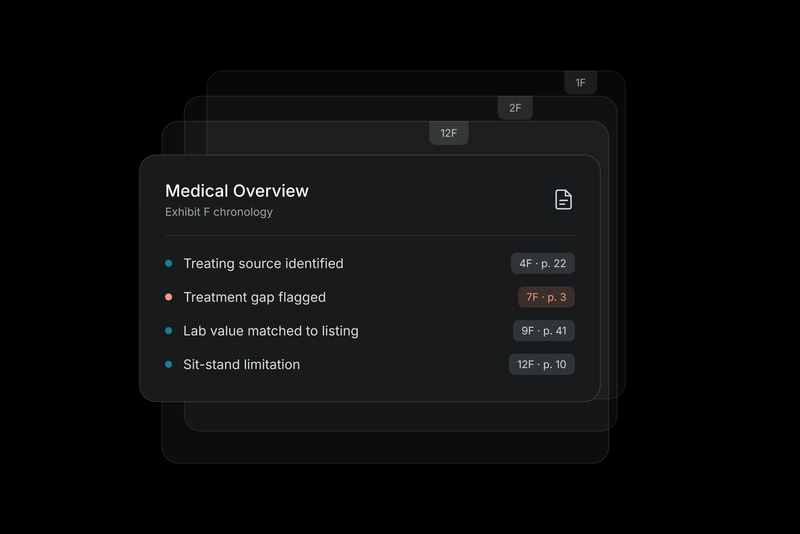
Eve was built for this work specifically. Its Medical Overview takes 30,000+ pages of records and returns a visit-by-visit treatment timeline in minutes, with ICD codes extracted, treatment gaps flagged, damages surfaced, and every entry linked to the source page. Records are processed under zero-retention terms in a secure, isolated environment and never used to train a model. Because matter context persists across the case, the chronology built at intake is still there when the demand letter, deposition prep, and discovery responses come due, so the heavy work happens once rather than every session.
General AI vs. AI medical chronology software: a direct comparison
| Dimension | General AI (ChatGPT, Claude, Gemini) | Eve (Purpose-Built Medical Chronology AI) |
|---|---|---|
| Data privacy / training | Inputs may train the model and be shared with third parties per the provider's privacy policy | Zero-retention; client data never used to train models |
| Data security | Public consumer service with no matter-level isolation | Encrypted in transit and at rest, US-hosted, isolated per matter |
| Document capacity | Context-window limits cap single-session processing at a fraction of a complex PI caseload | 30,000+ pages of records per medical chronology |
| Session memory | Resets between sessions; re-upload every time | Persistent across the full case lifecycle |
| Medical-legal context | Requires manual prompting | Built-in |
| Source citations | Absent or unverifiable | Linked to source document and page |
| Hallucination risk | Documented; model may omit critical records | Structurally reduced; documents are the source of truth |
| Prompt engineering required | Extensive for quality output | None |
| Research | Hallucinated citations are a documented risk | Case-law search plus trusted web search over curated, firm-vetted source collections; every result openably cited |
| Case lifecycle integration | Export only; each task starts from zero | Chronology flows into demand letters, depo prep, discovery |
The bottom line
A medical chronology is the foundation of a case: the demand letter, the deposition outline, the discovery responses, the trial prep. A tool that keeps that context across every downstream task, inside the same secure case environment, compounds the value at each step in a way that exporting a document and starting over in a new tool can't replicate.
Request a demo of Eve or read our complete guide to AI medical chronology for personal injury law firms.
Frequently asked questions
- Can lawyers use ChatGPT for medical records?
- It's risky. On consumer tiers, what you upload can be used to train the model and may be shared with third parties under the provider's privacy policy, which collides with an attorney's duty to keep client information confidential. Beyond data security, general AI tools also lack the document capacity, session memory, source citation capability, and medical-legal domain knowledge that reliable chronology work requires.
- What should a firm look for in an AI tool for medical records?
- Start with data handling: confidential records should be processed under zero-retention terms and never used to train a model. Then the capacity to take a full case file in one pass, persistent matter context so the work carries across the case, a source citation on every finding, and legal-domain knowledge built in rather than supplied through prompts. A tool that misses any of these pushes the work back onto your team. Eve was built to meet all of them.
- Why do AI tools hallucinate medical records?
- General AI models synthesize responses optimized for coherence and user satisfaction rather than exhaustive accuracy. In dense medical records, the model may skip records that aren't prominently featured, or generate plausible-sounding details that don't appear in the source. Purpose-built tools treat the uploaded documents as the sole source of truth and link every output claim to a specific page, which reduces this risk at the source.
- What's the difference between ChatGPT and AI medical chronology software?
- Purpose-built tools differ from general AI in three structural ways: they route tasks across multiple specialized models, they apply a legal-medical context layer before any document reaches a model, and they treat source documents as authoritative rather than synthesizing from training data. They also maintain persistent matter context across the case lifecycle, which general AI tools do not.
- How much of a medical record can general AI actually process?
- A general AI tool's context window limits what it can process and synthesize in a single session. Personal injury cases typically generate 500 to 5,000 pages of medical records; complex med-mal and catastrophic injury cases can run into the tens of thousands. Even where file uploads are technically possible, working across fragmented multi-session uploads destroys cross-record synthesis. Purpose-built legal tools are designed to handle full PI case files in a single secure environment.
- Do specialized AI medical chronology tools cite their sources?
- Yes. Purpose-built tools link every chronology entry to the specific document and page it was drawn from, allowing attorneys to verify any finding directly against the source record. General AI tools do not provide this level of source traceability.
Related Stories




The Tort Report
One email a week on the verdicts, the AI, and the money reshaping plaintiff law. Read by 500 leading plaintiff firms.
We could not load the signup form. Email us and we will add you to The Tort Report.
Email us