


The premier publication for plaintiff law
HR Called It 'Harmless Flirting,' We Called It Exhibit A.
On fighting back, betting on yourself, and why the solo has never had it better.

By Megan Thomas — 5 min read
The Tort Report
One email a week on the verdicts, the AI, and the money reshaping plaintiff law. Read by 500 leading plaintiff firms.
We could not load the signup form. Email us and we will add you to The Tort Report.
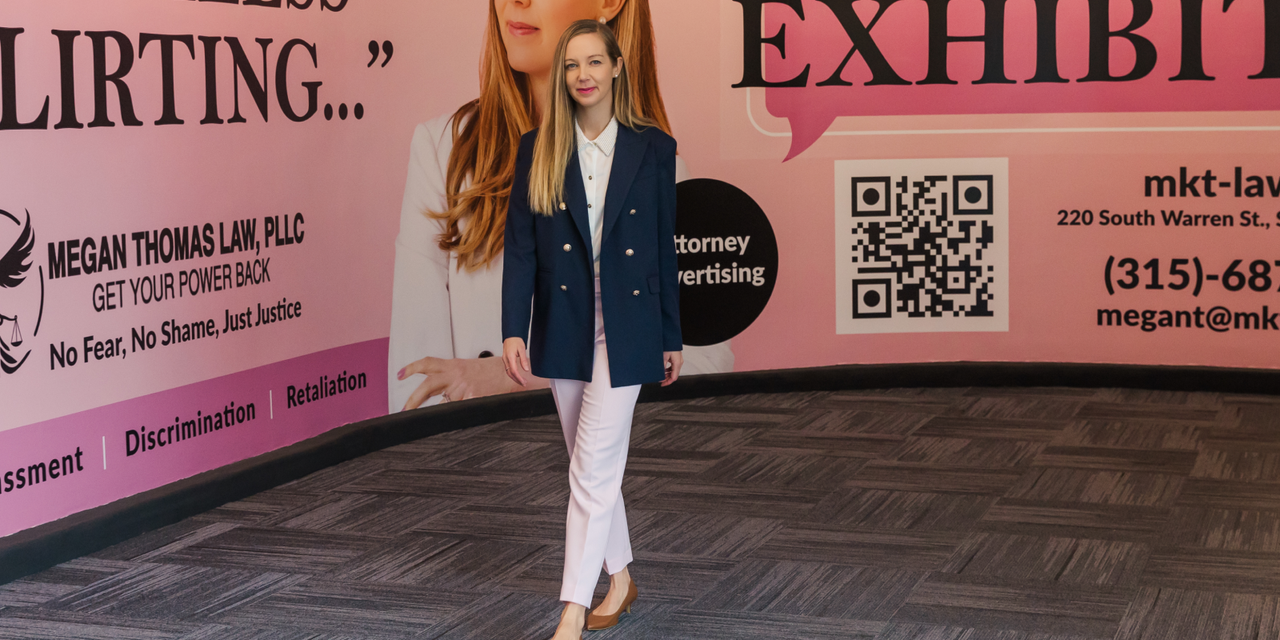
Email usThe Syracuse Regional Airport rejected my billboard that stated, “When HR called it Harmless Flirting, We called it Exhibit A." They said the ad could intimidate men, offend local politicians, and was a sensitive topic for travelers, including children. The airport, meanwhile, was running ads for male enhancement, breast augmentation, and plastic surgery without any apparent concern for the children.
I sued them in federal court.
The judge granted my preliminary injunction in January. He called the airport's defense nonsense. We settled in March. I now have two massive billboards up in the airport.
My practice is built around exactly that fight. I represent employees who have been harassed, retaliated against, or discriminated against in the workplace. I fight for people who were told they were overreacting, they should be grateful, or it wasn't a big deal. I know what it feels like to be in that position. And I know what it takes to fight back.
I Didn't Always Fight Back
I experienced harassment during my own career, more than once. There were times I stood up and times I didn't. The times I didn't still haunt me. I knew the next person would have to deal with the same thing, and I didn’t do enough to stop it. That guilt is part of what eventually pushed me to build something different.
I also spent years on the other side, watching how institutions respond when someone raises a complaint. I saw how HR handles these situations from the inside. I know the playbook. When my clients sit across from me and describe what happened to them, I understand it from multiple angles.
I recognized there was a gap in the market. There were so many people experiencing sexual harassment, discrimination, and retaliation in the workplace. The laws in NY were favorable to plaintiffs. But there just weren’t enough lawyers to help. Someone needed to be doing this work who genuinely got it. Eventually, I decided to build a practice around this work.
I started Megan Thomas Law in Syracuse, NY in 2024.
The A-Bomb
Most employment attorneys hold back in demand letters. Send a tight summary, protect your strategy, preserve your leverage for later. I do the opposite.
I call it the A-bomb. My demand letters go in heavy, 80 to 90 percent of what I have, organized chronologically, with exhibits embedded directly in the body of the letter. If he sent her a text on March 14th, that text is right there in the document. Not at the back. In the body. I want them to feel it.
The result is that defendants want to settle fast. They understand exactly what we will make public if they cannot resolve this at the early stage. With defendants who don’t settle, we head straight to litigation or administrative law complaints. Most defense attorneys and general counsels are used to getting two-page letters that are easy to set aside. I don't send those. My clients have been traumatized and need resolution as fast as possible to help them move on with their lives. The A-bomb gets them there.
My Second Chair Never Clocks Out
I'm a solo practitioner. I recently hired my first attorney, but for most of this firm's life it's been me, a part-time paralegal, and Eve. When people ask how I'm handling as many cases as I am, I tell them: I do have an associate. Her name's Eve, and she doesn't sleep.
The A-bomb letters used to take me 10 to 20 hours each. Now I import my previous demand letters as templates, upload the case facts, and add a legal memo for the specific area of law. Then I prompt Eve the way I'd brief a good associate: focus on this detail, connect this event to this legal theory, show how she was treated differently from her male colleagues at this specific work event.
I have a first draft in my voice, built around my strategy. That's not a workaround. It's how I scale without sacrificing what makes these letters work. Of course, I still have work left to do to prepare the final version, but it is a great starting point.
Employment cases live and die on documentation: timelines, behavioral patterns, HR communications, and comparator evidence. Building all of that out manually meant going through everything step by step and writing an outline that took forever. Now I move significantly faster on each file. I've roughly doubled the cases I can handle without cutting corners.
I also know for a fact that a lot of big defense firms aren't using AI yet. Some have blanket policies against it. So I'm a solo going up against a team of six attorneys, and I'm getting through the records faster than they are. That's never been true before. A solo practitioner has never had an efficiency edge over a large firm. Right now, we do.
Bet on Yourself
I started this firm while I was the primary breadwinner. Kids in private school. Mortgage. The pressure was real. But eventually, I did the math. I made a contingency plan. I took the leap.
The contingency fee model was also intentional. Almost everyone doing employment law in my market charges by the hour. I don't. A low-wage worker with a serious harassment claim can hire me. A high-performing employee who just got pushed onto a PIP after complaining about unequal pay can hire me without a $10,000 retainer. Barriers to entry for plaintiffs in these cases are already high enough. I wasn't going to add another one.
The result is, I’m able to help clients who need it. I’m also much happier. While I’m working a ton to build this practice, I can still work around my kids’ and family commitments. I set aside time to workout and recharge. I have more control over my own schedule and bank account than ever before.
The one thing I'd tell any attorney thinking about going out on their own: do the math, make a contingency plan, and stop waiting for someone to tell you that you're ready. Nobody's going to say that. Sometimes you have to take the leap without looking back.
Megan Thomas is the founder of Megan Thomas Law in Syracuse, New York, where she represents employees in sexual harassment, discrimination, and retaliation cases.
Related Stories


The Tort Report
One email a week on the verdicts, the AI, and the money reshaping plaintiff law. Read by 500 leading plaintiff firms.
We could not load the signup form. Email us and we will add you to The Tort Report.
Email us