


The premier publication for plaintiff law
What Makes the 10 Best Personal Injury Lawyer Commercials Work
Five principles. Ten commercials. What the best personal injury advertising has figured out that the rest of the category hasn't.

By Janet Choi — 6 min read
The Tort Report
One email a week on the verdicts, the AI, and the money reshaping plaintiff law. Read by 500 leading plaintiff firms.
We could not load the signup form. Email us and we will add you to The Tort Report.
Email usPersonal injury advertising is a billion-dollar category that most attorneys treat as a necessary evil and most viewers treat as background noise.
The firms on this list treat it as creative work.
Ten personal injury lawyer commercials, across markets, budgets, and approaches, that actually work. The results are measurable: Miley Legal saw a 19% sales lift when their campaign ran. Isaacs & Isaacs has 14 million YouTube views on a single spot. George Sink's jingle is so embedded in South Carolina that a four-year-old demanded a law firm-themed birthday party.
Five principles separate the personal injury lawyer commercials people remember from the ones they mute:
- The goal is to be remembered, not understood
- Ads built for a community outperforms
- The long game beats the one great ad
- The best PI ads are in on the joke
- Authenticity is a decision, not a style
PI lawyer ads succeed on recall, not comprehension
People make decisions based on what comes to mind most easily, according to Daniel Kahneman's availability heuristic. In personal injury law, the purchase decision happens in a crisis moment, often weeks or months after the ad ran. The only question is whose name surfaces first.
George Sink's "Call Nines" campaign turned a phone number into a jingle, then a music video, then a cultural artifact. When a four-year-old in South Carolina starts singing your number at church and demands a birthday party with your branding, the campaign has solved the availability problem completely.
Darryl Isaacs, known as ”The Hammer”, has been making Super Bowl commercials for his Kentucky personal injury firm for more than a decade. His 2020 Super Bowl spot (currently at 14 million YouTube views) gives a nod to Star Wars, includes the catchphrase “It’s Hammer time”, and there’s a horse astronaut.
None of this is exactly informative. All of it is unforgettable. In PI advertising, unforgettable is the metric.
Built from the inside out, not translated
Nielsen research on multicultural advertising consistently shows that ads created specifically for a community, rather than translated or adapted from general market campaigns, produce measurably higher brand recall and trust. Half of Hispanic consumers say they are more brand loyal to companies that honor and promote their culture. The audience can tell the difference between a firm that understands them and one that has translated a template.
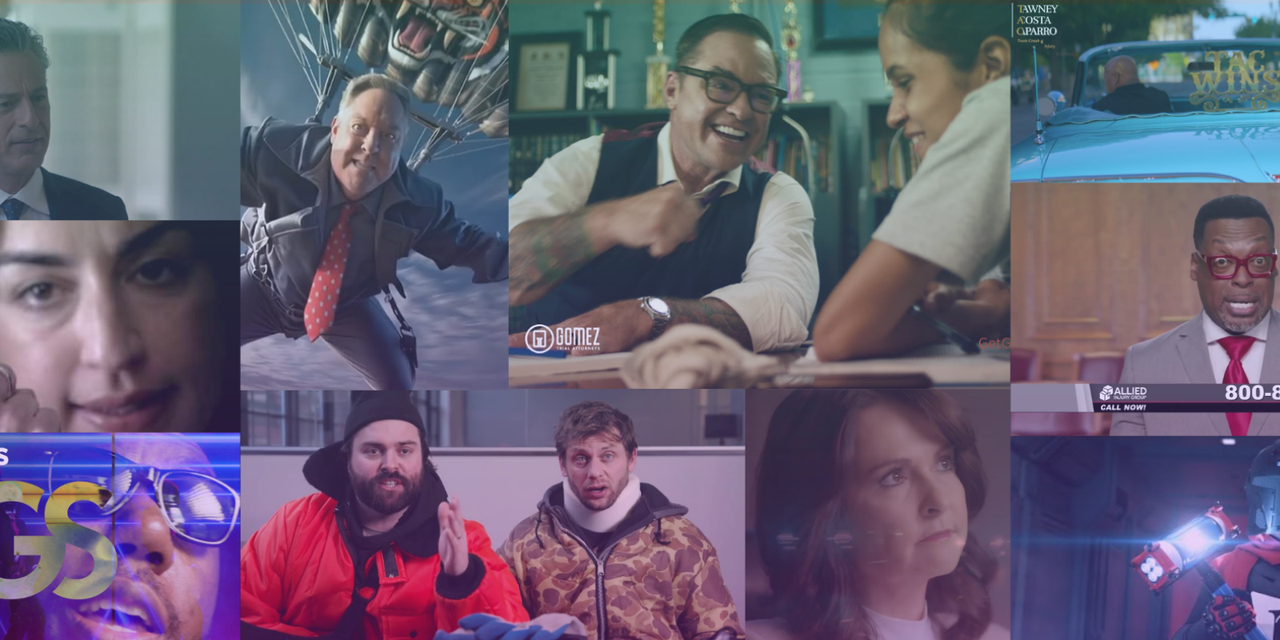
Tawney, Acosta & Chaparro didn't translate a template. "The Road to Justice," a lowrider rolling through the desert with chrome catching the sun, was built for Hispanic communities across the Southwest from the inside out. The lowrider is real. The tradition it honors is built into every frame: craftsmanship, pride, heritage. The firm still receives weekly calls and emails from people who stop what they're doing when the opening notes come on.
In San Diego, Gomez Trial Attorneys made a commercial that leads with Brandon Moreno, the first UFC Champion born in Mexico, and the Community Youth Athletic Center, a boxing and mentorship program for at-risk kids in National City. There's no settlement check and no phone number on screen. It's a firm that chose to show up for its community rather than sell to it.
Nicolet Law turned their attention to their Midwestern region. Charlie Berens and Myles Montplaisir, the comedians behind "The Snowmobile," already had a following for their Midwest culture content before this ad existed. The cultural details — a snowmobile from Milwaukee to Hudson, a Juicy Lucy stop in Eau Claire, a tackle box belonging to Mary Sorenson — aren't just regional color. They're signals to the audience that this ad was made by people who actually get them.
Consistency beats the great spot
People don't decide to like familiar things. They just do. In 1968, psychologist Robert Zajonc showed this with what became known as the mere exposure effect: repeated exposure to a stimulus increases positive feeling toward it, independent of any conscious evaluation.
Mike Morse didn't become a household name in Michigan from one commercial. He got there through twelve consecutive Super Bowl spots, long enough that his mother became a local celebrity, long enough that a fifteen-second ad about her fan mail room made complete sense to anyone who'd been watching.
Outside of video spots, Nicolet Law is also known for Russell Nicolet's cartoon face with mirrored sunglasses and pine trees in the lenses. It lives on more than 100 billboards across Minnesota and Wisconsin, plus beer cozies and temporary tattoos. The Star Tribune reported he may be more recognizable to Minnesotans than the governor.
It’s the compound interest of showing up the same way, year after year, until the brand starts having a life of its own.
The best PI ads are in on the joke
Robert Cialdini identifies liking as one of the core drivers of influence: we are more easily persuaded by people we like. Self-aware humor is one of the fastest routes to likability in PI advertising specifically, because it disarms the skepticism the audience already brings. When you make the joke about your own category before the audience does, you stop being the punchline.
The “Machete” ad from Trolman, Glaser & Lichtman starts like a typical personal injury commercial. A woman describes the worst pain of her life in maximum dramatic terms. But it turns out to be a paper cut. The closing line is: "If you've been injured, call us. But keep in mind, you really need to be injured." That one sentence acknowledges every skeptical thought the audience has ever had about PI advertising and turns it into a credibility signal. The confidence to write it, and the craft to make it funny, are both rarer in injury lawyer advertising than they should be.
Allied Injury Group went further. Shaun Jones, a 30-year standup veteran, plays "Your Favorite Attorney," a character modeled on Jackie Chiles from Seinfeld, himself a parody of Johnnie Cochran. Jones is not a lawyer. Allied is a referral service, not a firm. The commercial generated tens of thousands of TikTok posts, landed on the Cursed Commercials wiki, and prompted a legal ethics blog post. Jones now tours comedy clubs as the character.
The self-aware approach starts early in Miley Legal's "Wild Alternatives", which opens on an ad agency saying “we love the lawyer joke commercials but what about…”. Their pitches escalate for lawyer alternatives: race car driver, biker ("three wheels down of justice, baby"), jet skier with a bathrobe and baby oil. The Mileys' deadpan rejection of each one carries the whole joke. The firm ultimately saw a 19% sales lift when the campaign ran.
Authenticity is a decision, not a style
When people are genuinely absorbed into a story, they lower their critical defenses and stop counterarguing. Psychologists Melanie Green and Timothy Brock call this narrative transportation. Real stories transport more effectively than produced ones because credibility is the entry condition. Inauthentic emotion triggers the skepticism that blocks transportation before it starts.
Mama Justice, Missy Wigginton's Mississippi firm, could have hired actors. She didn't. "The Letter" is built around a real wrongful death case, a real client, and a real letter Wigginton wrote after the settlement. In a genre that often uses heartbreak as visual backdrop, the decision to build an ad around something true and unscripted is harder than it looks, and the audience knows the difference.
Personal injury lawyer commercials are their own creative genre, part brand advertising, part direct response, part cultural artifact, depending on who's making them. The firms that get it right have figured out that the goal isn't to look like a law firm. It's to be the one people remember when it matters.
Six of the firms on this list — George Sink, Mike Morse, Tawney Acosta & Chaparro, Mama Justice, Miley Legal, and Nicolet Law — are winners of the inaugural Torties, our award recognizing the best personal injury advertising in America.
Eve is the AI platform built exclusively for plaintiff law firms for case intake, medical summaries, demand letters, trial prep, and more. We'll leave the commercials to them. See what Eve can do.
Related Stories




The Tort Report
One email a week on the verdicts, the AI, and the money reshaping plaintiff law. Read by 500 leading plaintiff firms.
We could not load the signup form. Email us and we will add you to The Tort Report.
Email us